Antibody Education
.jpg?width=450&height=726&name=Image%20(10).jpg)

Every year, the Society for Neuroscience meeting feels a bit like stepping into a giant, living map of the neuroscience landscape. Not a tabletop, 2D representation of research topics and takeaways, but a three-dimensional world of research and relationships. It’s 5 days of charting Exhibitor booths numbering 1 to 4001 and poster board sections A to ZZ. Not to mention the steady stream of symposia, graduate and career fairs, networking sessions, Presidential Lectures, and countless other satellite events. Even after 12 years of attending this meeting, there seems to be no compass that can keep me from feeling blissfully overwhelmed.
Additionally, returning as an exhibitor these past 4 years has provided a refreshing vantage point and perspective, from which to absorb and appreciate the science while also seeing the full commercial ecosystem around it.
One of the strongest threads running through the meeting for us this year was the forward focus on more precise, more multidimensional, and earlier biomarker identification. We saw a lot of traction and interest in alpha synuclein, phospho forms of tau, TDP-43, progranulin, and many others.
This goal aligns closely with where Aviva has been investing our time and energy. Fluid biomarkers in particular offer a direct window into the biochemical changes that shape disease states. Robust assays allow researchers to quantify molecular activity with precision, capturing signals that cannot be inferred from structure or morphology alone. That distinction is becoming increasingly important as the field moves toward earlier readouts and more confident translational decisions.
Across posters and talks, biomarker discussions centered on early detection, assay sensitivity, translational readiness, and resolving low abundance signals.
One nanosymposium in particular "Choroid Plexus and CSF Biology" reshaped how I was thinking about CSF this year. Every talk approached the choroid plexus from a different angle, yet together they painted a surprisingly dynamic picture of an organ many of us tend to treat as a passive barrier or a simple fluid pump.
There were talks on mechanosensation in choroid plexus biology, on how loss of CSF production accelerates plaque load in mouse AD models, on age and amyloid beta dependent circadian changes in the choroid plexus, and on diurnal cycles that influence CSF composition and turnover. Each one highlighted a system that is far more active, regulated, and sensitive to disease state than I had fully appreciated.
What stood out was the growing understanding that CSF biology is not static. It changes with time of day, with aging, with pathology, and with mechanical and molecular cues. Those fluctuations may influence which proteins enter CSF, how long they remain detectable, and how their concentrations shift across disease progression. For those of us who build tools to measure protein biomarkers, that context matters.
It also intersects directly with a practical reality researchers face. Many relevant biomarkers originate or circulate through CSF, yet sampling CSF is invasive and rarely feasible outside specialized clinical settings. As a result, the field often relies on blood or serum, which means we need assays sensitive enough to detect low abundance (picograms per ml) CSF derived signals in matrices where they are diluted, degraded, or otherwise difficult to resolve.
For Aviva, this reinforced why our focus on fluid protein biomarkers is anchored in performance, reproducibility, and specificity. Detecting subtle changes in common sample types depends on antibodies that bind the right epitope with the right affinity and do so consistently across matrices. It depends on antibodies that distinguish isoforms and phospho states rather than blur them, remain stable in complex backgrounds, and generate clean signal even at low levels. In other words, the quality of the antibody underpins the quality of the assay, and the quality of the assay determines whether a biomarker is detectable at all in accessible sample types.
However, not all of the promising biomarker detection tools presented at SfN were fluid based! and this was a great reminder for me to look up and appreciate the breadth of neuroscience research and development. Though firmly planted in the world of molecular biology, I visited a group demonstrating a novel eye tracking platform, and they showed how subtle changes in saccade response timing can estimate cognitive age and signal neurodegenerative decline long before overt symptoms appear.
This kind of measurement sits outside the fluid biomarker space Aviva specializes in, but they may complement each other in meaningful ways. Behavioral and physiological markers capture systems level change. Protein level signatures capture cellular and molecular activity. Together, they can create a fuller picture of disease and offer clinicians a variety of tools to tackle diagnostic challenges.
For Aviva, fluid protein biomarkers remain a central focus because this is where high quality, reproducible antibody tools can make the largest scientific impact. The conversations at our booth reinforced this need. Researchers asked about sensitivity at low abundance, terminal end and isoform discrimination, and the challenge of validating targets in complex matrices.
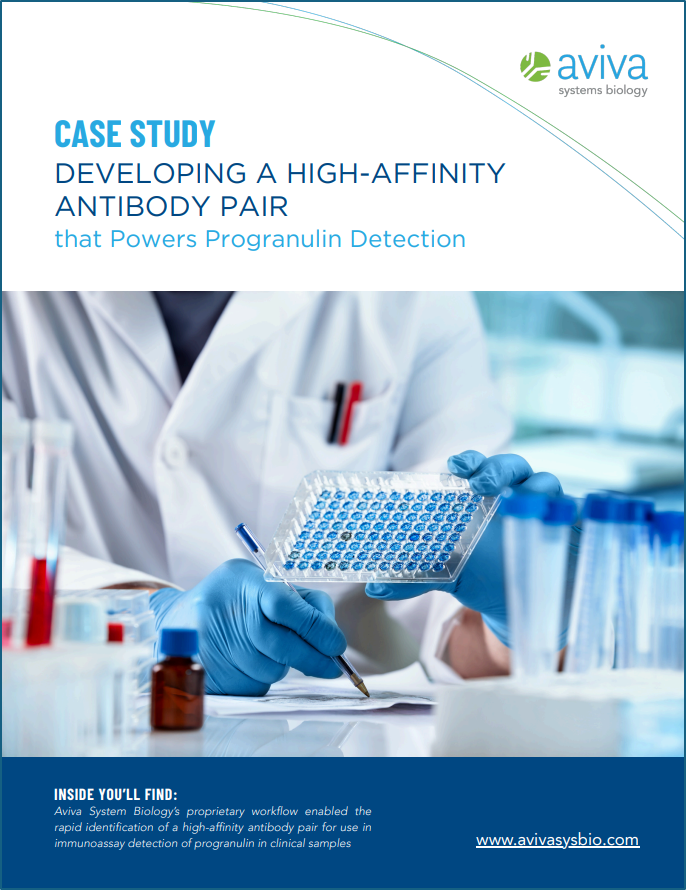
These are the exact questions we think about when we develop our recombinant antibodies, characterize and select pairs, and validate their performance for assay-ready-use. And our greatest example to date is demonstrated in this case study on Progranulin:
Developing a High-Affinity Antibody Pair that Powers Progranulin Detection
The field is moving toward a diagnostic landscape that integrates many types of signals rather than relying on a single marker or modality. We believe that fluid biomarkers will continue to anchor that ecosystem, supported by complementary technologies. It is an exciting direction, and it is one that Aviva is committed to supporting as researchers push for earlier detection, clearer readouts, and more meaningful translational insights.
As we head into a season of giving thanks, gratitude is on my mind. I am grateful for the researchers who stopped by and enthusiastically shared their work. Grateful for the colleagues who made the week seamless. Grateful for the momentum in our field and the sense that neuroscience is always building toward more collaborative, transparent, and translational progress. It is an honor and a privilege to be part of that.
Next year, we head to Washington DC. I’m already looking forward to the east coast visit and another chance to connect with this community. Conferences evolve, and so do we. And yet with each year, I walk away with the same feeling that there is still so much to learn, so much to build, and so much to be grateful for 😊
Warm regards,
.png?width=200&height=57&name=Untitled%20design%20(3).png)
Please note, these reflections represent my personal views and may not fully reflect the position of Aviva Systems Biology.