ELISA Resources


When studies appear in journals like Nature, Aging Cell, and Nature Communications, the bar is high and the underlying data need to be reliable. That puts real pressure on the antibodies and immunoassays used to detect pathway proteins, cytokines, and circulating markers in complex biological systems. At Aviva Systems Biology, we build research tools to help scientists make sharper measurements in immunology, inflammation, aging, and metabolism. The examples below show how Aviva reagents (and the targets they detect) connect to peer-reviewed studies of disease-relevant biology.
1. SPSB3 Antibody - C-terminal region (ARP71676_P050)
Innate immune sensing requires tight regulation. SPSB3 is a substrate-recognition component of an ECS or CUL5-based E3 ubiquitin ligase complex, and recent work has shown that it participates in regulating cGAS protein stability in the nucleus. Aviva’s SPSB3 Antibody (ARP71676_P050) is a rabbit polyclonal antibody raised against a synthetic 14 amino acid peptide in the C-terminal region of human SPSB3 and is validated for Western blot use.
In a 2024 Nature study, investigators identified SPSB3 as the cGAS-targeting substrate receptor within the CRL5 complex and used the Aviva SPSB3 antibody in both immunoblot and immunofluorescence workflows. That makes this a strong example of a reagent supporting mechanistic work on innate immune regulation rather than a generic expression readout.
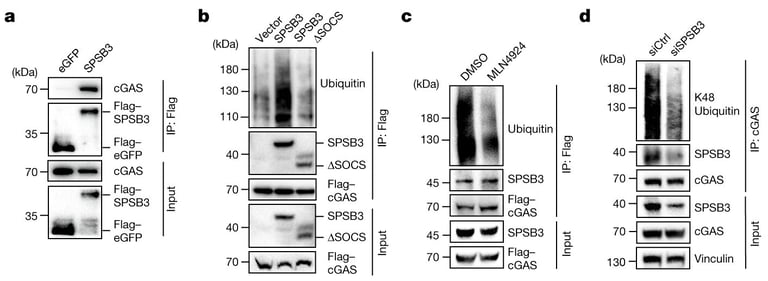 Fig. 2: CRL5–SPSB3 ubiquitylates cGAS. a, Immunoprecipitation (IP) of Flag-tagged SPSB3 or Flag-tagged eGFP from HEK293T cells transfected with cGAS and SPSB3-Flag or eGFP-Flag followed by immunoblot analysis. b, IP of Flag-tagged cGAS from HEK293T cells transfected with constructs for Flag-tagged cGAS, HA-tagged ubiquitin, empty vector, SPSB3 or SPSB3(ΔSOCS) followed by immunoblot analysis. c, IP of Flag-tagged cGAS from HEK293T cells transfected with cGAS-Flag, HA-tagged ubiquitin and SPSB3 followed by treatment with DMSO or MLN4924. The samples were analysed by immunoblotting. d, HeLa cells were treated with control siRNA or siRNA targeting SPSB3 for 3 days and analysed using immunoprecipitation with anti-cGAS antibodies. The samples were analysed by immunoblotting.
Reference: Xu, P., Liu, Y., Liu, C. et al. The CRL5–SPSB3 ubiquitin ligase targets nuclear cGAS for degradation. Nature 627, 873–879 (2024). https://doi.org/10.1038/s41586-024-07112-w
Product Code: ARP71676_P050
2. TNF Antibody - N-terminal region (ARP80342_P050)
TNF remains one of the central molecules in inflammatory signaling, and thus we’ve highlighted it before. It coordinates immune activation, host defense, and downstream cytokine biology, which is exactly why reliable detection matters when researchers are studying immune dysfunction at the molecular level. Aviva’s TNF Antibody (ARP80342_P050) is raised against the N-terminal region of human TNF and is validated for Western blot applications using human samples.
The 2024 Nature paper on inherited TNF deficiency used the Aviva N-terminal TNF antibody alongside a C-terminal TNF antibody to distinguish truncated intracellular TNF from mature secreted TNF. That experimental detail matters. It shows the reagent was part of a precise protein-level analysis used to define how a loss-of-function TNF variant disrupted antimycobacterial immunity.
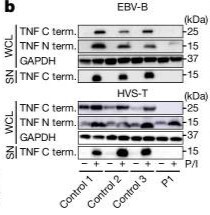
Fig. 2. The patients’ variant results in the loss of TNF production. b, Western blot analysis of supernatants and whole-cell lysates (WCL) from EBV-B and HVS-T cells from healthy controls and P1 with and without PMA and ionomycin (P/I) stimulation. Representative image from three independent experiments.
Reference: Arias, A. A., et al. Tuberculosis in otherwise healthy adults with inherited TNF deficiency. Nature 633(8029), 417-425 (2024). https://doi.org/10.1038/s41586-024-07866-3
Product Code: ARP80342_P050
3. LRG1 ELISA Kit (Mouse) (OKCD01614)
Circulating proteins can be useful only if they are measured in a way that is consistent and interpretable. LRG1 is a secreted glycoprotein linked to inflammation, angiogenesis, and tissue remodeling, and Aviva’s Mouse LRG1 ELISA Kit (OKCD01614) is a sandwich ELISA designed for serum, plasma, and other biological fluids.
In Aging Cell, researchers studying anesthesia- and surgery-induced cognitive impairment in aged mice measured LRG1 concentrations using OKCD01614. The broader study connected DNMT3a deficiency to reduced methylation at the Lrg1 promoter, increased LRG1 expression, and downstream TGF-β signaling. That gives this example stronger scientific footing than a simple biomarker mention, it places LRG1 inside a defined mechanistic model of age-related cognitive decline after surgery.
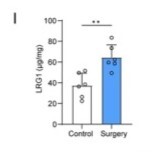 Figure 5. Loss of DNMT3a results in hypomethylation and upregulation of LRG1. (I) LRG1 concentration in the hippocampal tissue between control and surgery group (n = 6).
Reference: Cong, P., et al. DNMT3a Deficiency Contributes to Anesthesia/Surgery-Induced Synaptic Dysfunction and Cognitive Impairment in Aged Mice. Aging Cell 2025 Apr;24(4):e14458. https://doi.org/10.1111/acel.14458
Product Code: OKCD01614
NNMT is increasingly recognized as a meaningful link between metabolism and disease biology. As a cytosolic enzyme that methylates nicotinamide, it influences NAD+ pathways, methyl donor balance, and broader cellular programs tied to stress response, inflammation, and metabolic adaptation.
Aviva’s anti-NNMT antibody (OAAN01939) supports protein-level detection of NNMT in research samples, giving scientists a practical tool for studying how NNMT expression shifts across injury models and disease states. In pathways where metabolic remodeling has functional consequences, reliable antibody-based detection helps connect protein expression to mechanism.
In the cited Nature Communications study, researchers showed that the NNMT/1-MNA axis protected against hepatic ischemia-reperfusion injury through the AKT/FOXO1/ANGPT2/JNK pathway. The study positioned NNMT as more than a metabolic marker - it was part of the mechanism itself. That makes NNMT a relevant target in translational research and a good example of where strong target detection supports stronger biological interpretation.
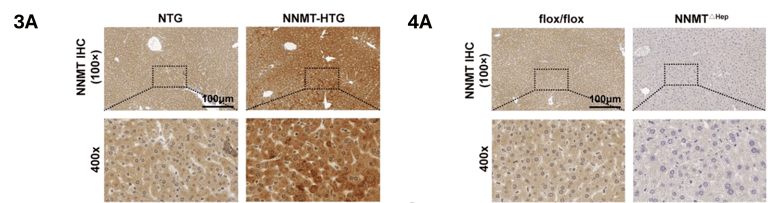
Figure 3A and Figure 4A demonstrate Hepatocye-specific Nnmt overexpression and Hepatocye-specific Nnmt knockout, respectively, via IHC stain.
Reference: NNMT/1-MNA protects against hepatic ischemia-reperfusion injury through the AKT/FOXO1/ANGPT2/JNK axis. Nature Communications 16(1), 4779. https://doi.org/10.1038/s41467-025-59968-9
Product Code: OAAN01939