Antibody Education


ELISA is one of the most widely used tools for protein measurement, but a reliable assay is never just a plate plus two antibodies. Performance depends on how well the assay matches the biology of the target, the complexity of the sample matrix, the expected concentration range, and the practical realities of the workflow.
In many cases, an off-the-shelf ELISA kit is the right place to start. But when your target is novel, your samples are challenging, or your performance requirements are unusually demanding, a custom assay may be the better path.
This guide outlines the key factors to evaluate when deciding between a ready-made ELISA kit and custom assay development.
An off-the-shelf ELISA kit is often a good choice when the target is well characterized, the sample type matches the kit’s validated matrix, and speed and budget matters. These kits are useful for routine measurements, screening studies, and standardized workflows where convenience and established performance are important.
A custom assay becomes more valuable when the biology is more difficult or the question is more specific. That may include:
The most important point is simple: do not choose an assay simply because it is available. Choose the one that is most likely to answer your biological question accurately.
Before comparing kits or planning custom development, define exactly what the assay needs to measure and why.
A kit validated for one sample type may not perform the same way in another. A recombinant standard may not fully reflect the endogenous analyte in a native biological sample. If the analytical goal is not clear at the start, it becomes much harder to judge whether an assay is truly fit for purpose.
Before you browse catalogs or start development, ask:
Clear assay requirements help prevent a common mistake: optimizing an assay that performs well technically, but does not measure the biology you actually care about.
For sandwich ELISAs, the antibody pair is central to assay performance. The capture and detection antibodies must bind different, non-overlapping epitopes that remain accessible in the native analyte. If that pairing is weak, poorly matched, or vulnerable to interference, sensitivity and specificity can suffer.
This is especially important when working with endogenous proteins that may be folded differently, processed, complexed with other molecules, or modified after translation.
When evaluating or developing a sandwich ELISA, consider whether the antibody pair:
One practical challenge with some commercial kits is limited transparency around the antibodies used. That does not automatically mean a kit is poor, but it can make troubleshooting and long-term risk assessment more difficult.
An assay that performs cleanly with recombinant protein in buffer may behave very differently in real samples. Biological matrices can introduce interference from abundant proteins, lipids, enzymes, heterophilic antibodies, pH variation, or other components that alter signal generation or binding.
This is one of the most common reasons an assay that looks strong during initial testing performs inconsistently in actual study samples.
To assess matrix compatibility, test the assay in the sample type you plan to use. Useful checks include:
As a general benchmark, many teams look for spike recovery in a reasonable range such as 80 to 120 percent, but acceptable criteria should always be set in the context of the assay’s intended use.
Detection chemistry affects sensitivity, dynamic range, ease of use, and instrument requirements. In standard ELISA workflows, HRP with a colorimetric substrate such as TMB is often a practical and reliable choice. It is familiar, accessible, and well suited for many routine applications.
But not every target behaves like a routine target. Low-abundance analytes may require a more sensitive format, and the best option depends on both assay performance needs and available instrumentation.
Before committing to a format, make sure you understand:
Higher sensitivity is not automatically better if it comes with more noise, narrower usability, or instrument mismatch.
The standard curve is what turns optical signal into concentration data, so its design has a direct impact on assay accuracy.
A common issue is that the standard material does not behave like the endogenous analyte. Recombinant proteins can differ in folding, truncation state, glycosylation, or other structural features, and those differences can influence antibody recognition. Even when the assay is technically consistent, the reported concentration may still be biased if the reference standard is not a good match.
To strengthen curve performance:
A strong curve is not just smooth. It should also reflect the biology you are trying to measure.
Whether you use a commercial kit or a custom assay, the real question is how it performs in your lab, with your operators, your instruments, and your samples.
Vendor validation data can be helpful, but it does not replace fit-for-purpose verification under your actual working conditions.
At minimum, evaluate:
For some use cases, CV targets such as 10 to 15 percent within a run and 15 to 20 percent across runs may be reasonable starting points, but acceptance criteria should reflect the assay’s intended application rather than a generic rule.
If a commercially available kit has been validated in your matrix, covers your expected range, and aligns with your study goals, it may be the fastest and most efficient route.
If your target is harder to measure, your matrix is more complex, or your performance requirements leave little room for compromise, custom assay development may be the better investment.
The right choice is the one that gives you confidence in the answer, not just convenience in the workflow.
Reliable ELISA data starts with the right fit between assay design and biological question.
Start by defining what you need to measure, in which sample type, and with what level of confidence. Then evaluate the core variables systematically: antibody pair quality, matrix behavior, detection format, standard curve design, validation, and workflow fit.
Off-the-shelf kits can be an excellent solution. Custom development can be the right one when the question is tougher. The goal is not to choose the simplest assay. It is to choose the one most likely to produce meaningful data.
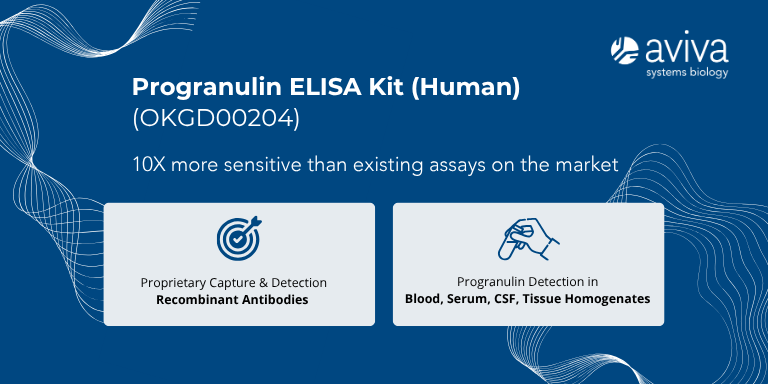
Aviva offers both off-the-shelf ELISA kits and custom assay development services to help researchers choose the right path for their biology, matrix, and study goals. Whether you need a catalog assay for faster project turnaround or a more tailored solution for a difficult target, our team can support the work. To see an example of our custom assay capabilities, take a look at our new Progranulin ELISA and the associated case study, which highlights how the assay was developed and characterized to support reliable biomarker measurement.